
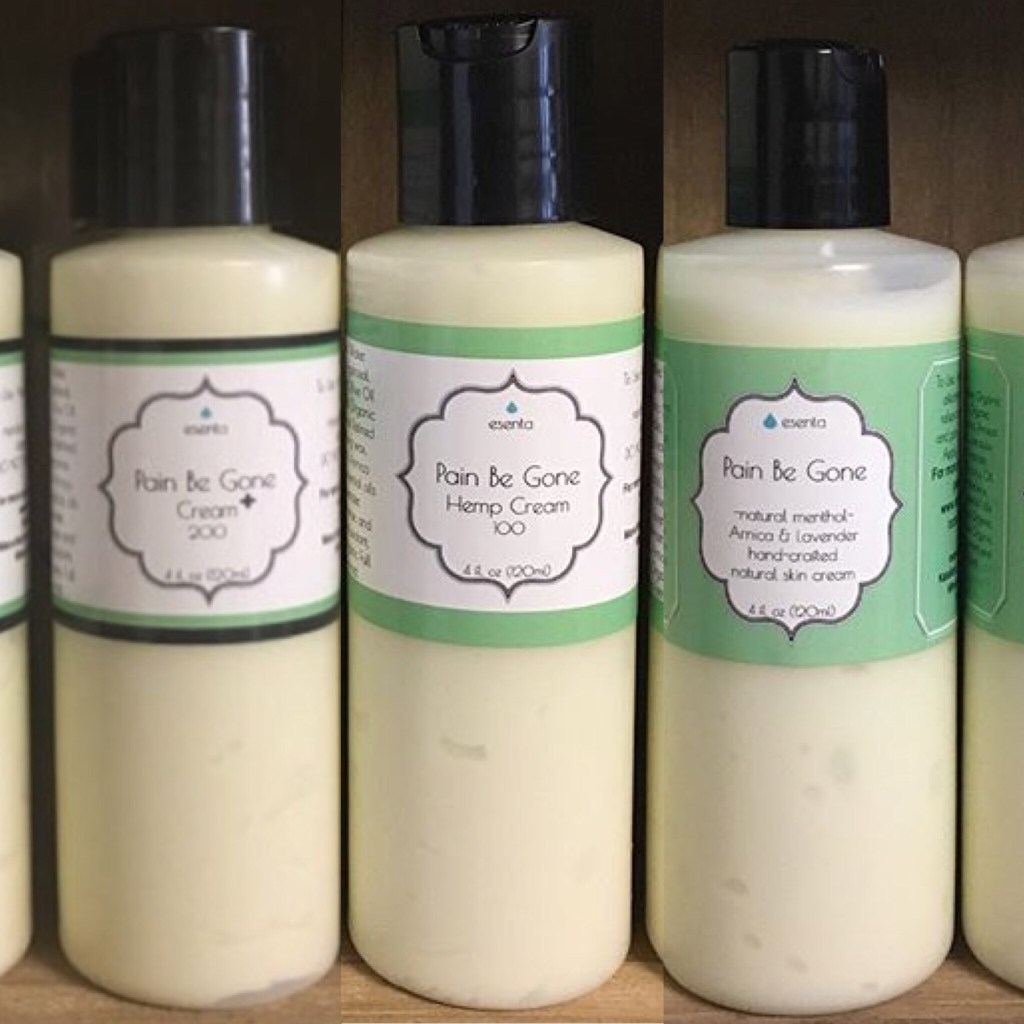
Have you always wanted to try my Pain Cream? Would you want to be part of my product testing?
I am putting together a package of small bottles of my three varieties of Pain Be Gone Cream and would love your feedback. 💜
My Pain Be Gone Cream is one of my most popular and longest standing products that I’ve made for more than 10 years now. I originally created it for my grandmother’s sciatica pain, as she said the codeine that she was prescribed made her feel “loopy.” She was so surprised by the relief that she got while using the pain relieving cream, she called me a miracle worker. She hasn’t been the only one who has said this after using the cream. (I’ve even said it out loud, to myself, after standing on my feet all day in heels at conventions.)
Through the years hemp extract has been of interest to my customers, so I added it to a few of my products after I secured a local provider of organic full spectrum CO2 extract. I decided to create two different strengths to fit people’s budgets. People continue to comment how effective the cream is. 💖
So now I want to know… does adding hemp extract make my product more effective, or is it just an expensive ingredient? Do I just need a little of it in my products, or a lot?!
As an aromatherapist, I understand that there is a safety load to essential oils due to their concentrated nature, and that a higher percentage of essential oils in a product doesn’t necessarily make it more effective… as there is a threshold.
However in the case of hemp extracts, there is a range of products on the market with different strengths. Many of them don’t even detail the amount of CBD or hemp extract that is in their products. 🤷♀️
Along side being a product developer for my own product line for more than 12 years, I was a product developer for a CBD company for a couple of years as well, so creating quality products that are crafted precisely, is my jam. I also teach medicine making at a local herb school, and still my brain wants to know more!
My Pain Be Gone Cream is truly artisan crafted in small batches. It is made with natural organic ingredients, including: Distilled Water, Organic Lavender Hydrosol, Organic Aloe Vera, Organic Olive Oil, Organic Castor Oil, Organic Coconut Oil, Organic Refined Shea Butter, Org. Calendula and Lavender Blossoms, Organic Comfrey Root, Emulsifying Wax, and the essential oils of organic Eucalyptus, organic Lavender, organic Clove, organic Peppermint, and Wildcrafted Frankincense, rosemary antioxidant, and loads of love.
I’m putting together a little package of samples at a wholesale price for testing, and would like to know if you would be willing to test my products and give me feedback?
Yes? Awesome!! In exchange for the cost of making the product I will be shipping you three mysteriously labeled 2 oz bottles of various strengths of my Pain Be Gone Cream. One made with just essential oils; one made with 50 mg of CBD, and the third made with 100mg of CBD, in exchange for $40, which includes shipping.
Along with the products, I will be sending you a small little questionnaire that I would like emailed back to me. In exchange for helping me out, I will award you a lifetime discount of 30 % off all of my Pain Relieving Products. 💜
To maximize efficiency and timing for shipping them all out, this offer is only available through October 2020. Packages will be shipped out the first week of November. 💜 You can order your sample set now by following this link. Please make sure to include your shipping address.
https://checkout.square.site/buy/QOD4XUJUYUMZGH33MYH7HLNT
Thank you for supporting my small business and for your participation in my product testing study. I look forward to getting your feedback!

 Roots of Alchemy