education, Essential Oils, Wellness

Historical Solutions to Airborne Illness: Aromatics

By Kathryn Delaney, CCA, CCH, CN

With what looks to be escalating news regarding the coronavirus (Covid-19), health professionals are still learning how it spreads, to what extent it can spread, and the severity of illnesses that it causes.

There is currently no vaccine to prevent COVID-19. The best way to prevent illness is to keep up your immune system and avoid being exposed. Like other respiratory illnesses, and similar to the common cold, the virus is thought to spread mainly from person-to-person. Either between people who are in close contact with one another (within about 6 feet), or through respiratory droplets produced when an infected person coughs or sneezes. These droplets can land in the mouths or noses of people who are nearby or possibly be inhaled into the lungs.

Essential oils are unique allies in times of airborne illness because of their volatile nature and their inherent anti-bacterial, anti-microbial and sometimes anti-viral qualities. Essential oils are distilled from plants into concentrated volatile substances that can not only purify the air… this quality makes them extremely effective for respiratory conditions by way of inhalation. It is this diffusive quality that allows them to be used to strengthen the immune system.

Historically aromatic herbs and spices have proven useful in times of airborne illnesses because of their anti-microbial, anti-bacterial and anti-viral properties. Aromatic botanicals have been used for centuries in religious ceremonies that use smudging as a means of spiritual purification, and some traditions of the past and present, continue to smudge people and public areas as a means to purify the air, such as: juniper, cedar, cypress, and other botanicals.

Several ways you can use the benefits of anti-viral essential oils are detailed below:

  • Steam Inhalation – Simply boil a soup pot filled with water, remove from stove, and add 4 drops of any singular or combination of any of the following: Bay Laurel, Tea Tree, Cajeput, Thyme, Niaouli, or Ravintsara.
  • Passive Diffusion – Set a bowl of water, with a few drops of the essential oils listed above, in a warm sunny window. Alternatively, you can place 8-10 drops in a inhaler to breathe throughout the day.
  • Room Diffusers and Atomizers are also practical ways to disperse the anti-viral qualities of essential oils into larger spaces, such as living rooms, etc.
  • Topically, a person can apply Bay Laurel, Cajeput, Niaouli, or any of the Eucalyptus Essential Oils on the lymph nodes and adrenal glands after a shower. This will help to strengthen the immune system. To do this, dilute a total of 3-10 drops of a single or combination of these oils in an unscented lotion or vegetable oil, and massage on the sides of the neck, arm pits, lower back and just above the kidney.
  • Disinfectant Room sprays – Add 20-30 drops of essential oil to 4 oz of purified water. Shake well before using.
  • Household cleaners – Add 20-30 drops of essential oil to a spray bottle with 6 oz water and 2 oz white vinegar. Shake before use, and make sure you test on a corner of surface before using on the entire surface.

Many of the discoveries of the benefits of using aromatic plants to prevent and treat respiratory conditions, came out of the European area.

In the 16th century, also known as the Golden Age of Herbalists, pomanders of myrrh, sandalwood, cloves, nutmeg and rose, were popular, as well as lemon peel, juniper oil, camphor and marjoram. Pomanders were small, ball-like vessels that were stuffed with aromatic plants. These were worn around the neck or on a belt.

In a popular illustration from the 17th Century, a doctor is pictured wearing protective clothing that can be best described as a hood with a beak. This vessel is said to have been filled with cinnamon, clove and other aromatic herbs. (Battaglia, 2008)

Doctors Visit 17c.

During the 19th century, someone observed the low incidence of tuberculosis in the flower-growing districts of France, particularly in the south. It was here that someone made note that the workers who processed flowers and herbs remained free of the respiratory illness that was common at that time. This led to published studies showing that essential oils were able to kill the micro-organisms of glandular and yellow fever. They particularly noted the properties of oregano, Chinese cinnamon, angelica and geranium. (Battaglia, 2008)

Epidemics of the past were worsened by several factors, including:

  • Rapid growth of urban areas with poor sanitation
  • Horrific working conditions in factories – dawn to dusk, 7-day work week
  • Epidemic vitamin D deficiency – rickets in some urban areas nearly universal
  • Deterioration of the diet
  • Sugar and white flour as staple foods for the first time in history


As a reminder, Center for Disease Control recommends these everyday preventive actions to help prevent the spread of respiratory diseases, including: “Avoid close contact with people who are sick; and washing your hands often with soap and water for at least 20 seconds, especially after going to the bathroom; before eating; and after blowing your nose, coughing, or sneezing. If soap and water are not readily available, use an alcohol-based hand sanitizer with at least 60% alcohol. Always wash hands with soap and water if hands are visibly dirty.”

To keep up your healthy immune response:

  • Reduce unnecessary stress. Stress has been shown to be the first domino that effects all illnesses.
  • Make sure you get adequate sleep. Sleep deprivation causes elevated cortisol levels and results in impaired immune function.
  • Become replete in Vitamin D.
  • Reduce Sugar intake. Americans consume an average of five ounces (> ¼ lb.) of sugar every day, either consciously added to their food or hidden in processed foods. Scientific studies have found that amounts less than this can profoundly suppress the immune system.


It is key to remember how important basic self-care is, in building our immunity, especially as modern lifestyles seem to command for stressful ways of living. While many of us may be familiar with the relaxing benefits that aromatherapy can have on our stress levels, it’s pretty cool that these aromatic allies have qualities that have proven them to be invaluable during times of legendary epidemics.


About the Author: Kathryn Delaney, CCA, CCH, CN is the Director of Aromatherapy 100 Course at the Colorado School of Clinical Herbalism.

For more information on the new course, please visit: For more information on the upcoming course, starting April 14th, please visit: https://clinicalherbalism.com/programs-courses/aromatherapy/ or write to Kathryn.delaney@clinicalherbalism.com


DIY, education, Essential Oils

Introducing Esenta – The Aromaticum App., your guide to blending essential oils

esentablack

The Esenta Aromaticum App is now available as helpful resource on essential oils, providing guidance in choosing the appropriate oils for a particular use, and to help you get to know the range of uses applicable. My goal in creating this app was to provide you with information that empowers the safe use of essential oils in and around the home, in aim that it assists with improving the quality of everyday life.

Throughout my years of study, I’ve made several essential oils reference guides for myself, and found them to be very practical and useful. People often call or write to me with frantic questions, so in effort to make the information more readily available I recently linked up with a friend from my youth and we created the Esenta Aromaticum App.

This guide features more than 100 alphabetically sorted essential oils and their benefits; it is also a quick reference to ailments and conditions paired with the associated essential oils that have been shown through historical use to lend assistance and relief. Additionally, comprehensive descriptions of applications for safely using essential oils are explained in detail.

Esenta is currently available now for iPhones, if enough interest is revealed it may become available for Android systems as well. Let me know what you think by commenting below!!

#essentialoils #DIY #aromatherapy #blendingresources #pocketreference #aromatherapyapp #aromatherapysafety #essentialoilsafety #essentialoiledu

DIY, education, Essential Oils

Aromatherapy Blending Resource Guide

Often times when I am speaking to people about products that they are making they ask about conversions and how to make blends within certain concentrations. I have posted some conversion charts below for reference. Examples of how to use these charts follow.  Feel free to post your questions regarding blending in the comment section below!

Example #1  ~  Product: Massage Oil

Let’s say you wanted to make a massage oil to use on clients, family members, or for personal use. I suggest making a small amount to determine if you like the texture and scent of the blend prior to preparing a larger volume. In classic aromatherapy the recommended dilution for a massage oil is a 2% concentration.

To make 1 oz of massage oil you would need roughly two Tablespoons of a carrier oil/lotion  (e.g. olive oil, sweet almond oil, virgin coconut oil, etc.) and a total of 12 drops of essential oils. Once you have decided on a blend and carrier that you like, you can expand this recipe to a larger volume. For instance, 4 oz of carrier oil(1/2 cup), with a total of 48 drops of essential oils.

Conversion Chart

Drops to Volume

20 drops   =

1/5 teaspoon

=          1ml

100 drops    =

1 teaspoon

=            5 ml

300 drops    =

1 Tablespoon

 =          15 ml

600 drops    =

1 ounce

=          30 ml

Blending Concentrations

(per volume)

Bottle Size Total Volume Drops per [1%] Drops per

[2%]

Drops per

[3%]

Drops per

[4%]

1/3 oz=

10 ml

2

4

6

8

½ oz =

15 ml

3

6

9

12

1 oz  =

30 ml

6

12

18

24

2 oz   =

60 ml

12

24

36

48

4 oz   =

120 ml

24

48

72

96

8 oz   =

240 ml

48

96

144

192

copyrighted by Roots of Alchemy 2019

#aromatherapy #diy #essentialoils #blendingguide #percentagechart #aromatherapyresource
education, Essential Oils, Wellness

Why Ingestion of Essential Oils should be Reconsidered, a Clinical Aromatherapists point of view

Many people have been led to presume that an essential oils’ quality dictates its safety. However, in addition to an essential oil’s quality there are specific guidelines and safety precautions that people should be aware of when working with essential oils. A classic designation of quality essential oils is that they be “therapeutic grade,” this is the quality of essential oils that every Aromatherapist and practitioner should be using regardless of the application. However, despite an essential oil being classified as “therapeutic grade,” an essential oil may still be determined unsafe for internal, and in some cases topical, use.

I have worked with and studied essential oils for more than 20 years and my entire reference library has always discouraged the ingestion of essential oils except in instances when a person is under the direct guidance of an experienced health care professional. You can imagine my surprise when I began working for a company that sells essential oils, where customers regularly call to ask if the oils are safe for ingestion. The majority of individuals who called admitted to ingesting essential oils purchased from an alternate company; In my professional opinion, I find this to be concerning.

The repeated inquiry and social media regarding ingesting essential oils stirred my interest in investigating why essential oils are traditionally discouraged from being ingested in classic aromatherapy.  What follows is a combination of my research and my reasoning on the subject.

The Food and Drug Administration, while it has not regulated the use of essential oils as therapeutic remedies, has designated some varieties of plant species that essential oils are distilled from as GRAS, or Generally Regarded As Safe. The FDA created this distinction in respect of various plant matter being used as additives for food and drink flavorings. Some essential oil companies have taken the liberty to refer to the GRAS list as a determinant for the safety of ingesting essential oils. This is not a logical deduction due to the following distinctions made by the FDA.

“The U.S. Food and Drug Administration’s (FDA’s) pre-market approval processes for food and color additives require an estimate of the probable consumer intake of the additive to determine whether its use or presence in a food at a given concentration is safe.”(1)

The amount of any plant material in extract form which is used to flavor food and beverages is very dilute, and is always prepared in its medium in a controlled environment. The GRAS list was produced in consideration of use being in much lower concentrations than what people are consuming in the practice of ingesting essential oils for therapeutic or supplemental value.
While researching the parameters which designate a substance as GRAS, I came across some frequently asked questions regarding the subject which should be highlighted here. One of these questions asked: “If a substance is designated as GRAS, is it safe for all uses?”

The response to this question was as follows:

“Not necessarily. Under section 201(s) of the Act, it is the use of a substance, rather than the substance itself, that is eligible for the GRAS exemption (62 Fed. Reg. 18939; April 17, 1997). A determination of the safety of the use of an ingredient includes information about the characteristics of the substance, the estimated dietary intake under the intended conditions of use, and the population that will consume the substance (proposed 21 CFR 170.36 (c)(1)(iii)).”(2)

This lead me to inquire how this designation was originally determined, and what an “estimated dietary intake under the intended conditions of use,” was intended to mean in regard to the amount ingested.

“The key determinant in the safety evaluation of a substance found in or added to the diet is the relation of its probable human intake to the level at which adverse effects are observed in toxicological studies. Simply, “the dose makes the poison.” The implications of this adage as it pertains to food can be illustrated with two examples.  While “pure” water can be viewed as the safest of foods, excessive intake can lead to a potentially fatal electrolyte imbalance.  Conversely, pure concentrated sulfuric acid can destroy human tissue, but FDA has affirmed it as GRAS for controlling pH during the processing of alcoholic beverages or cheeses.  Clearly, conditions of use and dose (i.e., intake) are considered jointly when discussing the safety of a component of food.”(1)

This clarification is important to consider when in question regarding the safety of oral doses of essential oils, as the GRAS list was not created nor intended to be used as a reference to ingesting concentrated essential oils, but rather, the plant extracts being used to flavor food and beverages. Based on the designations above, one can reasonably presume that the dosage amounts that individuals are ingesting of essential oils, negate the application of the GRAS designation as a determination of safety for internal use of essential oils. This is of key importance, as people are wrongly using the GRAS list as a measure for safe ingestion for therapeutic values, which the GRAS list was not intended for.

When using essential oils for their therapeutic properties it is important to consider that essential oils are highly concentrated, volatile liquid compounds that vary in their chemical constituents and ultimate effects on the body.  There are several ways essential oils are extracted, for example classic steam distillation (flowers, grasses, bark, some citrus), cold-pressed method (rind of citrus), and cohobotation (rose Otto) or hydro-distillation (resin), there is now an additional CO2 extraction which is a relatively new method on the market. The amount of essential oil that a plant produces, varies. For instance:

Cinnamon Bark

1,300 lbs

5 oz

Cypress

2,000 lbs

16 oz

Eucalyptus

25 lbs

16 oz

Jasmine

1,000 lbs

16 oz

Lavender

200 lbs

16 oz

Peppermint

256 lbs

16 oz

Rose

16,000 lbs

16 oz

Rosemary

50 lbs

16 oz

It was hard for me to imagine what these figures visually look like in volume so I broke down the weights even further.

Cinnamon Bark

260 lbs

1 oz (30 ml)

Cypress

125 lbs

1 oz (30 ml)

Eucalyptus

1.56 lbs

1 oz (30 ml)

Jasmine

62.5 lbs

1 oz (30 ml)

Lavender

12.5 lbs

1 oz (30 ml)

Peppermint

16 lbs

1 oz (30 ml)

Rose

1,000 lbs

1 oz (30 ml)

Rosemary

3.13 lbs

1 oz (30 ml)

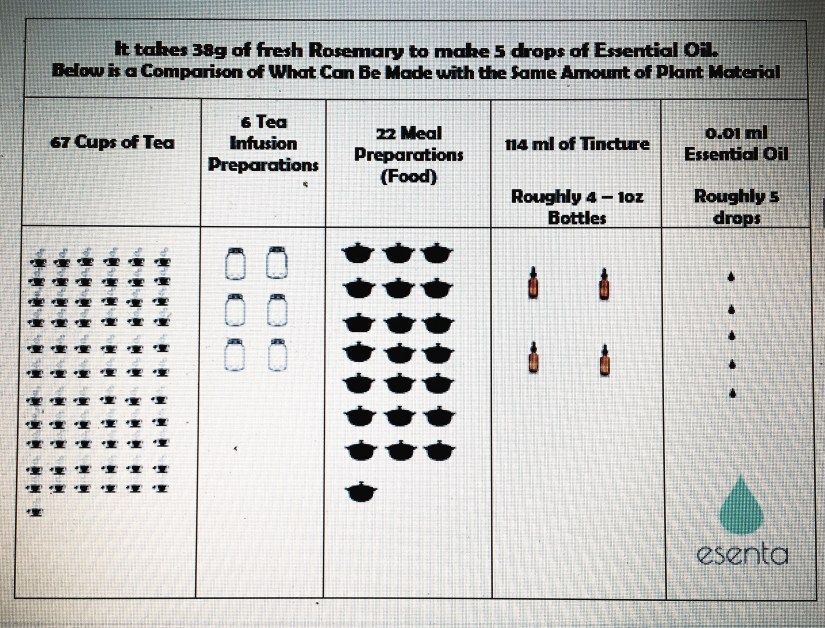
Considering in traditional measures there are on average 20-30 drops of essential oil in a milliliter, there are 600 – 900 drops of essential oil in a 30 ml bottle of essential oil (the size of an actual drop depends greatly on the tool which is being used to dispense them, a euro-reducer dispenses a larger drop than a pipette, for instance). When people consume 3-4 drops in a capsule they are actually consuming quite a large amount of active compounds from plant material.

There are a few reasons why it concerns me that people are ingesting essential oils, one of which is the means of which I am hearing of people ingesting them. What primarily concerns me is instances when I hear that people are ingesting several drops of essential oil in a glass of water.

You might ask…why does this concern me?

By their nature, essential oils float on water. By dropping them into water, without any dispersant, the essential oils ultimately coat a person’s throat and then the lining of their stomach, without any means to slow their absorption.

If you were to, for instance, eat the equivalent of the herb of oregano as it would take to make the amount of drops of oregano essential oil some people are ingesting under the suggestion of some MLM representatives (despite classic aromatherapy discouraging any use of this oil whatsoever in aromatherapy except under guided use), one could presume their body may give them feedback to stop eating the herb by some means or another ie. vomiting, excessive sweating, etc. However, when someone chooses to ingest an essential oil, the body cannot reject it because it is instantly bio-available. In the instance of using oregano, it would likely give a burning sensation as oregano is a mucus membrane irritant.

Ultimately, drinking tea regularly has been shown to be an effective remedy without the necessity of a huge amount of plant material needed to be distilled and without possible negative side effects of ingesting essential oils. When we compare a common over the counter medication to the concentrations of ingesting essential oils we can compare for instance, the practice of taking 2 Advil or Tylenol for a headache as compared to taking a handful of them, which could be deadly.

I bring this up to clearly display that essential oils are highly concentrated volatile plant substances. The strain on one’s liver, the ultimate filter of the body, when one ingests essential oils is quite different when compared to regularly drinking a glass of tea.

In “The Illustrated Encyclopedia of Essential Oils: The Complete Guide to the use of Oils in Aromatherapy and Herbalism,” by Julia Lawless, she states very specifically in the safety guidelines “DO NOT TAKE ESSENTIAL OILS INTERNALLY! This rule is in accordance with the guidelines of safety recommended by International Federation of Aromatherapy. Essential oils do not mix with water, and in an undiluted form they may damage the lining of the digestive tract. In additional some essential oils are toxic if taken internally.”

Several years ago I came across the directions for ingestion in a single source, which surprised me as all of the other reference books that I have studied throughout the years have held a similar standing, and discouraged the ingestion of essential oils unless under the guidance of a professional. All of the course books that I received in the certification program I took part in also forewarned against ingesting essential oils without guidance. This particular source appeared to be published as an offshoot of Young Living, a popular Multilevel Marketing company which had a tiered system of selling essential oils. The book detailed many of the blends that are sold through the company, and had referenced uses that were in much higher concentrations than any other reference book I have in my library. It was in this book that I first saw reference to the FDA’s GRAS list as being a designation for the safety of internal use of essential oils.

My growing concern and interest in the subject matter led me to look into the research of Robert Tisserand and his guidelines regarding essential oils.

In the book he coauthored, “Essential Oil Safety: A Guide for Health Care Professionals,” he differentiates and explains what can be described as acute and chronic toxicity established from improper use of essential oils. For instance there can be acute oral toxicity, as in the case of a lethal dose of ingestion, and there is also acute dermal toxicity, which speaks to signs of systemic toxicity when specific oils are applied to the skin, and then there is also chronic toxicity, which speaks to the adverse effects of using an essential oil through either dermal application or otherwise, from the repeated use of essential oils both internally and externally.  The material states: “Toxicity is a risk because of the possibility of cumulative effects where damage will increase after each small dose.” It goes on to say:

“Chronic toxicity is, like acute toxicity, dose-dependent but it will also depend on frequency and total length of time of application. There is a link with acute toxicity in the sense that small, frequently applied amounts of essential oils which are acutely toxic are very likely to be chronically toxic. This is another link in that there are frequently similar causes of death in both cases — most commonly damage to liver and  kidneys.”

In his book, Tisserand documented the toxicity levels as determined by a test, typically referred to as the LD50 test. This scientific method determines the toxicity of the material in question by the amount of gram of material ingested/kilogram of weight, would result in fifty percent of the test subjects’ fatality. In other areas of the book, there are instances of poisoning detailed, as well as other examples of poisoning. While poisoning is noted at relatively minimal doses, because the oil did not kill a subject, or show evidence of being fatal for 50 percent of the population tested under three designated proportions, it was determined “safe for use unless there are reasons not to.”

With that in mind I re-read the source I came across that suggested directions and cautionary measures when it comes to ingesting essential oils. “Essential Oils Desk Reference, ” compiled by Essential Science Publishing, stated that:

“All essential oils that are Generally Regarded As Safe (GRAS) or certified as Food Additives (FA) by the FDA may be safely taken internally as dietary supplements. But ingesting essential oils should only be done under the direction of a knowledgeable health professional.”

The following paragraph continues:

“In fact, many oils are actually more effective when taken orally in very small amounts. Essential oils should always be diluted in vegetable oil, blue agave nectar or rice milk prior to ingestion. . . Usually no more than 2-3 drops should be ingested at one time (during a 4-8 hour period). Because essential oils are so concentrated, 1-2 drops are often sufficient to achieve significant benefits.”

I have to admit that I am a bit alarmed when people reveal to me that they are ingesting 4 drops of essential oil or more in a sitting, often times just in water, others admit to filling gelatin capsules and ingesting them without any carrier at all.

There is great importance to pay attention to that fact that when it comes to using essential oils in this way, the nature of essential oils themselves is that they float on water. Research that has shown benefits of ingesting small amounts of lavender, for instance, is done in a controlled environment when capsules were prepared with a combination of lavender essential oil in a base of virgin coconut oil. Ingestion in this way is different than by means of dropping a few drops in  a water glass because essential oils inherently float on the surface of the water, which is likely why the EDR suggests using agave nectar as a dispersant.

While there is research being produced that shows evidence of ingesting essential oils being effective and suitable in acute situations, I strongly believe that daily ingestion for means of basic supplement is unnecessary and ultimately unsustainable.  I am also increasingly concerned about the use of this practice when it comes to the antibacterial nature of essential oils and their possible negative effects on the internal gut biome.

When one considers that having a daily practice of drinking tea regularly can have similar benefits as supplementing with essential oils, but without the risk of acute oral toxicity, or chronic toxicity, it seems wise to consider saving the method of ingesting essential oils for times when it is absolutely necessary, and again, under the guidance of an experienced health care professional.

* Some essential oils are less viscous and may be counted out drop by drop to have more drops per milliliter, which is why when blending it is always best to use a milliliter as a measurement for consistency of product rather than preparing things in ratio by drop.

1) Guidance for Industry: Estimating Dietary Intake of Substances in Food. Source: Food and Drug Administration. August 2006. Authors: Hyoung Lee and Alison Edwards.

http://www.fda.gov/Food/GuidanceRegulation/GuidanceDocumentsRegulatoryInformation/ucm074725.htm#subs

2)Guidance for Industry: Frequently Asked Questions About GRAS.U.S. Department of Health and Human Services Food and Drug Administration Center for Food Safety and Applied Nutrition (CFSAN) December 2004.

#aromatherapy #essentialoileducation #essentialoils #holistictherapy #ingestingessentialoils #Essentialoilsafety #essentialoilguidelines


DIY, education, Essential Oils, Wellness

Herbal Extracts: Differentiated and Defined

Compound

An end product that is comprised of two or more substances mixed together. Herbal compounds may have an end product in a salve, tablet, gel-cap, tincture, or oil form.

CO2 Extractions

Super-critical CO2 distillations are a cold-temperature extraction process considered to be superior to other methods because during the technique of CO2 extraction the plant material is not exposed to heat. In this process, CO2 is pressurized to become liquid, macerates with the plant material, and then is filtered out. The resulting material is allowed to come to room temperature so that the carbon dioxide can vaporize off, resulting in a think waxy end product. While CO2 distillations are becoming more popular in the essential oil market, as they allow for a more delicate distillation of plant matter, it is arguable if a Super-critical CO2 extract can be considered a true essential oil by definition due to the waxy nature of the end product. Essential oils by definition are miniscule molecules that can pass through the skin and are volatile by nature. (Read more about how CO2 distillations compare to Essential Oils here.) In the Super-critical CO2 distillation process, the majority of these volatile compounds and terpenes are destroyed, however in the sub-critical CO2 distillation process, they can be saved. Where we most often see CO2 extractions, is in the realm of food and drink flavorings, and recently in the realm of the hemp industry. While in the former the CO2 extracts can be referred to as true extracts, in the latter realm we see a range of products classified as CO2 extracts that have ultimately gone through many other clarifying processes ranging from winterization, fractionizing, and filtering, among others in an aim to refine the end product.

Decoction

A medicinal tea made from boiling plant material, usually the bark, rhizomes, roots or other woody parts, in water. May be used therapeutically. Natural dyes are often also made this way.

Flower Essence

Homeopathic dilutions of flowers systematized by Edward Bach, MD that are most commonly used to address emotional and subtle mental imbalance. Flower Essences are very subtle energetic medicine. One could say that an imprint of the energetic qualities of a flower or plant are captured and cured for use to remedy various “negative” emotional states. Flower essences do not have a scent of their original mother plant and are primarily made up of water and small amount of brandy. A trained therapist is able to create a customized flower essence that helps to shift the energetic patterns of an individual to a state of well-being over time. Flower essence remedies are typically taken in water, and have a flavor of faint brandy, as this is the spirit most are cured and purified with. If a person is sensitive to alcohol, disperse of it by dispensing the 3-4 drops of flower essence blend into 1 cup of just boiling water, pour into clean ceramic cup and allow to cool prior to drinking. The minute amount of alcohol will vaporize out.

Homeopathy

Classically referred to by using the phrase “like cures like,” Homeopathic medicine is able to stimulate the body’s response to an illness or disease by introducing very minute dilutions of the same substance causing the negative reaction. By taking theses plant substances and diluting them, for instance, 1 drop in 99 drops of water, and then again, and then again… Homeopathic medicines are able to stimulate the body’s response to an illness or disease by introducing very minute dilutions of the same substance. For instance, while a tea of Arnica Montana has been found to be poisonous if ingested, a homeopathic of Arnica Montana is often used to reduce swelling, bruising and pain prior to surgery, as well as traditionally being used topically for the same purposes. A Homeopathic formula that is labeled 6X, has been diluted 6 times, 10X has been diluted 10 times, and 10C has been diluted 100 times. The more dilute, in this instance, the more potent the homeopathic remedy.

Infusion

A tea made by pouring water over plant material (usually dried flowers, fruit, leaves, and other parts, though fresh plant material may also be used), then allowed to steep. The water is usually boiling, but cold infusions are also an option. May be used therapeutically, as hot tea or wound wash. Infusion preparations are an excellent way to administer herbs into the body as the mineral component of herbs can be readily absorbed.

Essential Oils

Volatile aromatic oils extracted from the leaves, stems, flowers, and other parts of plants by means of either steam distillation, hydro-distillation, or cold-pressing. Therapeutic use traditionally includes a 2% dilution due to the nature of the highly concentrated oil.

Glycerite

 An herbal glycerite is an alternative to an alcohol tincture. The benefit of taking herbal preparations this way is that it allows one to avoid the ingestion of alcohol, and is often best suited for children. While sole passive glycerin extractions are said to not extract much medicinal compounds when compared to alcohol. Alcohol extractions have shown to denature and render inert many of the organic compounds.  Recent herbalists have discovered that a combination of water and glycerin in a ratio specific to each plant, yields a much more superior end material that is truer tasting to the fresh plant. At typical dosage for this type of medicinal varies depending on the plant but is typically ¼ tsp. 1-3 times per day.

Herbal Infused Oils

A process of extraction in which the volatile oils of a plant substance are obtained by soaking the plant in a carrier oil for approximately two weeks and then straining the oil. The resulting oil is used therapeutically and may contain the plant’s aromatic characteristic.

Percolation

A process to extract the soluble constituents of a plant with the assistance of gravity. The material is moistened and evenly packed into a tall, slightly conical vessel; the liquid (menstruum) is then poured onto the material and allowed to steep for a certain length of time. A small opening is then made in the bottom, which allows the extract to slowly flow out of the vessel. The remaining plant material (the marc) may be discarded. Many tinctures and liquid extracts are prepared this way.

Tincture

An extract of a plant made by soaking herbs in a dark place with a desired amount of either glycerin, alcohol, or vinegar for two to six weeks. The liquid is strained from the plant material and then may be used therapeutically. Alternatively, tinctures can be made by percolation  method.

Liniment

Extract of a plant added to either alcohol or vinegar and applied topically to employ the therapeutic benefits.

Poultice

A therapeutic topical application of a soft moist mass of plant material (such as bruised fresh herbs), usually wrapped in a fine woven cloth.

©Esenta Botanicals 2016


Kathryn Delaney is a Certified Clinical Aromatherapist, Flower Essence Therapist, and Practicing Herbalist. She compounds herbal formulations with more than 20 years of experience and also offers consultations and holistic education. The above list is a small compilation of some of the definitive terms from the Urban Shaman Workbook that will be going into print soon. If there are additional terms you would like explained in this blog, please leave a comment below. Fall classes will be offered through the internet soon, to be invited, Kathryn can be contacted at esentabotanicals@gmail.com.