DIY, Wellness

DIY Natural Cold Remedy: Learn How to Make Your Own Oxymel

Colds and respiratory conditions tend to sneak up on us at the change of seasons. Rather than reach to an over-the counter remedy that removes the symptoms but prolongs a cold,  my favorite go-to remedy at the sign of the sniffles is my Oxymel.

To understand what Oxymel is, the word comes from the Greek language. “Oxy” (sour), and “Mel” (sweet) is a description of the flavor profile of this traditional remedy. Simply, Oxymel is a combination of Raw Apple Cider Vinegar and Honey. For decades modern herbalists have come to infuse these two substances  with a variety of herbs, which tailors the remedy and its effective outcomes.

I first experienced Oxymel while I was in herbalism school. I had a respiratory cold where my nose was running so badly that I was going through a pile of tissues. I sat in the furthest corner of a local coffee shop, struggling through homework, and a pile of waded up napkins. Unfortunately, I was also under a deadline to get my homework done for school, and found myself sacrificing self-care for meeting responsibility. (Note to self: Bad Vitalist!). As one of my professors used to say, “when you are an herbalist you grow to look forward to getting sick, just so you can try out the effectiveness of a remedy.”   

The next morning I decided to go to the store and get some ingredients for a remedy that I had learned about in school called “Oxymel”. It called for apple cider vinegar, honey, fresh turmeric, garlic, ginger, lemon and red pepper flakes. I purchased the necessary items at the store, wrote to my teacher to let her know I wouldn’t be in class that day, and  began making my brew immediately.

After four hours of infusing the honey and apple cider vinegar with the herbs, I strained the contents, combined the two infused liquids together, and took a shot glass of the formula. The formula had a kick of heat, but finished with a sweetness.  In a half hour I took another tablespoon. I repeated this two more times and went to bed. By the next morning I felt one hundred percent better. The shift in how I felt was so profound, and immediate, that I was amazed how sick I had been just 24 hours prior. Needless to say, Oxymel is now my go-to remedy any time I feel a hint of a cold.

To see how to make your own oxymel formula, visit my YouTube channel here. Making Oxymel isn’t an exact art. You can flavor your oxymel for your own palette. I made my original recipe with oranges, and peppers that I grow in my garden, along with some additional carminative seeds. 


Oxymel

To make your own oxymel you will need the following: 

500 ml raw local honey

500 ml raw apple cider vinegar

one handful of chopped raw turmeric, chopped

1 four” knot of fresh ginger root, chopped

2 full garlic bulbs, peeled and chopped

1 whole lemon, chopped (with skin)

one tsp. pepper flakes

In the recipe that I made on YouTube, in: DIY Cold Remedy: Learn How to Make Your Own Oxymel I added the optional ingredients of:

1 orange

6 small cinnamon sticks

1 cup of dried hawthorn berries

2 Tbsp. Fennel

Again, you can adjust your formula for your palette and what you have around the house. You could also add ingredients such as: horseradish, onions, wasabi, sage, herbs for the respiratory system, ect. Make sure you write down your recipe in case you want to make the same one again.

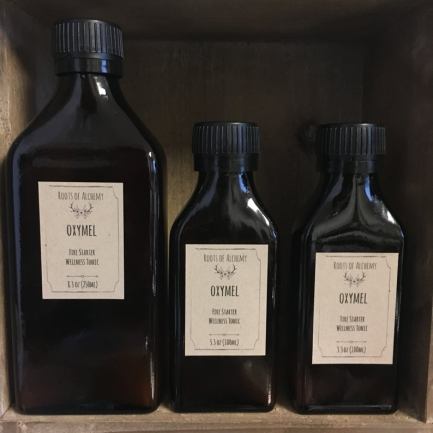
This will keep for 1 1/2 years if kept in the fridge. I personally go through what I make every year, so I have yet to have any go bad on me. Roots of Alchemy Fire Starter Oxymel has become one of my best selling products in the Winter Season. Roots of Alchemy Fire Starter Oxymel can be purchased on Etsy, here and is available for sale in two sizes.

Oxymel has become one of my most used and trusted remedies during the winter season. I’d love to hear about how my video inspired your creations. Be Well!

DIY, education, Essential Oils

Introducing Esenta – The Aromaticum App., your guide to blending essential oils

esentablack

The Esenta Aromaticum App is now available as helpful resource on essential oils, providing guidance in choosing the appropriate oils for a particular use, and to help you get to know the range of uses applicable. My goal in creating this app was to provide you with information that empowers the safe use of essential oils in and around the home, in aim that it assists with improving the quality of everyday life.

Throughout my years of study, I’ve made several essential oils reference guides for myself, and found them to be very practical and useful. People often call or write to me with frantic questions, so in effort to make the information more readily available I recently linked up with a friend from my youth and we created the Esenta Aromaticum App.

This guide features more than 100 alphabetically sorted essential oils and their benefits; it is also a quick reference to ailments and conditions paired with the associated essential oils that have been shown through historical use to lend assistance and relief. Additionally, comprehensive descriptions of applications for safely using essential oils are explained in detail.

Esenta is currently available now for iPhones, if enough interest is revealed it may become available for Android systems as well. Let me know what you think by commenting below!!

#essentialoils #DIY #aromatherapy #blendingresources #pocketreference #aromatherapyapp #aromatherapysafety #essentialoilsafety #essentialoiledu

DIY, education, Essential Oils

Aromatherapy Blending Resource Guide

Often times when I am speaking to people about products that they are making they ask about conversions and how to make blends within certain concentrations. I have posted some conversion charts below for reference. Examples of how to use these charts follow.  Feel free to post your questions regarding blending in the comment section below!

Example #1  ~  Product: Massage Oil

Let’s say you wanted to make a massage oil to use on clients, family members, or for personal use. I suggest making a small amount to determine if you like the texture and scent of the blend prior to preparing a larger volume. In classic aromatherapy the recommended dilution for a massage oil is a 2% concentration.

To make 1 oz of massage oil you would need roughly two Tablespoons of a carrier oil/lotion  (e.g. olive oil, sweet almond oil, virgin coconut oil, etc.) and a total of 12 drops of essential oils. Once you have decided on a blend and carrier that you like, you can expand this recipe to a larger volume. For instance, 4 oz of carrier oil(1/2 cup), with a total of 48 drops of essential oils.

Conversion Chart

Drops to Volume

20 drops   =

1/5 teaspoon

=          1ml

100 drops    =

1 teaspoon

=            5 ml

300 drops    =

1 Tablespoon

 =          15 ml

600 drops    =

1 ounce

=          30 ml

Blending Concentrations

(per volume)

Bottle Size Total Volume Drops per [1%] Drops per

[2%]

Drops per

[3%]

Drops per

[4%]

1/3 oz=

10 ml

2

4

6

8

½ oz =

15 ml

3

6

9

12

1 oz  =

30 ml

6

12

18

24

2 oz   =

60 ml

12

24

36

48

4 oz   =

120 ml

24

48

72

96

8 oz   =

240 ml

48

96

144

192

copyrighted by Roots of Alchemy 2019

#aromatherapy #diy #essentialoils #blendingguide #percentagechart #aromatherapyresource
DIY, education, Essential Oils, Wellness

Herbal Extracts: Differentiated and Defined

Compound

An end product that is comprised of two or more substances mixed together. Herbal compounds may have an end product in a salve, tablet, gel-cap, tincture, or oil form.

CO2 Extractions

Super-critical CO2 distillations are a cold-temperature extraction process considered to be superior to other methods because during the technique of CO2 extraction the plant material is not exposed to heat. In this process, CO2 is pressurized to become liquid, macerates with the plant material, and then is filtered out. The resulting material is allowed to come to room temperature so that the carbon dioxide can vaporize off, resulting in a think waxy end product. While CO2 distillations are becoming more popular in the essential oil market, as they allow for a more delicate distillation of plant matter, it is arguable if a Super-critical CO2 extract can be considered a true essential oil by definition due to the waxy nature of the end product. Essential oils by definition are miniscule molecules that can pass through the skin and are volatile by nature. (Read more about how CO2 distillations compare to Essential Oils here.) In the Super-critical CO2 distillation process, the majority of these volatile compounds and terpenes are destroyed, however in the sub-critical CO2 distillation process, they can be saved. Where we most often see CO2 extractions, is in the realm of food and drink flavorings, and recently in the realm of the hemp industry. While in the former the CO2 extracts can be referred to as true extracts, in the latter realm we see a range of products classified as CO2 extracts that have ultimately gone through many other clarifying processes ranging from winterization, fractionizing, and filtering, among others in an aim to refine the end product.

Decoction

A medicinal tea made from boiling plant material, usually the bark, rhizomes, roots or other woody parts, in water. May be used therapeutically. Natural dyes are often also made this way.

Flower Essence

Homeopathic dilutions of flowers systematized by Edward Bach, MD that are most commonly used to address emotional and subtle mental imbalance. Flower Essences are very subtle energetic medicine. One could say that an imprint of the energetic qualities of a flower or plant are captured and cured for use to remedy various “negative” emotional states. Flower essences do not have a scent of their original mother plant and are primarily made up of water and small amount of brandy. A trained therapist is able to create a customized flower essence that helps to shift the energetic patterns of an individual to a state of well-being over time. Flower essence remedies are typically taken in water, and have a flavor of faint brandy, as this is the spirit most are cured and purified with. If a person is sensitive to alcohol, disperse of it by dispensing the 3-4 drops of flower essence blend into 1 cup of just boiling water, pour into clean ceramic cup and allow to cool prior to drinking. The minute amount of alcohol will vaporize out.

Homeopathy

Classically referred to by using the phrase “like cures like,” Homeopathic medicine is able to stimulate the body’s response to an illness or disease by introducing very minute dilutions of the same substance causing the negative reaction. By taking theses plant substances and diluting them, for instance, 1 drop in 99 drops of water, and then again, and then again… Homeopathic medicines are able to stimulate the body’s response to an illness or disease by introducing very minute dilutions of the same substance. For instance, while a tea of Arnica Montana has been found to be poisonous if ingested, a homeopathic of Arnica Montana is often used to reduce swelling, bruising and pain prior to surgery, as well as traditionally being used topically for the same purposes. A Homeopathic formula that is labeled 6X, has been diluted 6 times, 10X has been diluted 10 times, and 10C has been diluted 100 times. The more dilute, in this instance, the more potent the homeopathic remedy.

Infusion

A tea made by pouring water over plant material (usually dried flowers, fruit, leaves, and other parts, though fresh plant material may also be used), then allowed to steep. The water is usually boiling, but cold infusions are also an option. May be used therapeutically, as hot tea or wound wash. Infusion preparations are an excellent way to administer herbs into the body as the mineral component of herbs can be readily absorbed.

Essential Oils

Volatile aromatic oils extracted from the leaves, stems, flowers, and other parts of plants by means of either steam distillation, hydro-distillation, or cold-pressing. Therapeutic use traditionally includes a 2% dilution due to the nature of the highly concentrated oil.

Glycerite

 An herbal glycerite is an alternative to an alcohol tincture. The benefit of taking herbal preparations this way is that it allows one to avoid the ingestion of alcohol, and is often best suited for children. While sole passive glycerin extractions are said to not extract much medicinal compounds when compared to alcohol. Alcohol extractions have shown to denature and render inert many of the organic compounds.  Recent herbalists have discovered that a combination of water and glycerin in a ratio specific to each plant, yields a much more superior end material that is truer tasting to the fresh plant. At typical dosage for this type of medicinal varies depending on the plant but is typically ¼ tsp. 1-3 times per day.

Herbal Infused Oils

A process of extraction in which the volatile oils of a plant substance are obtained by soaking the plant in a carrier oil for approximately two weeks and then straining the oil. The resulting oil is used therapeutically and may contain the plant’s aromatic characteristic.

Percolation

A process to extract the soluble constituents of a plant with the assistance of gravity. The material is moistened and evenly packed into a tall, slightly conical vessel; the liquid (menstruum) is then poured onto the material and allowed to steep for a certain length of time. A small opening is then made in the bottom, which allows the extract to slowly flow out of the vessel. The remaining plant material (the marc) may be discarded. Many tinctures and liquid extracts are prepared this way.

Tincture

An extract of a plant made by soaking herbs in a dark place with a desired amount of either glycerin, alcohol, or vinegar for two to six weeks. The liquid is strained from the plant material and then may be used therapeutically. Alternatively, tinctures can be made by percolation  method.

Liniment

Extract of a plant added to either alcohol or vinegar and applied topically to employ the therapeutic benefits.

Poultice

A therapeutic topical application of a soft moist mass of plant material (such as bruised fresh herbs), usually wrapped in a fine woven cloth.

©Esenta Botanicals 2016


Kathryn Delaney is a Certified Clinical Aromatherapist, Flower Essence Therapist, and Practicing Herbalist. She compounds herbal formulations with more than 20 years of experience and also offers consultations and holistic education. The above list is a small compilation of some of the definitive terms from the Urban Shaman Workbook that will be going into print soon. If there are additional terms you would like explained in this blog, please leave a comment below. Fall classes will be offered through the internet soon, to be invited, Kathryn can be contacted at esentabotanicals@gmail.com.

DIY, education, Essential Oils, Wellness

Oils of Alchemy 101 – Dilutions and Applications

Essential Oils are wonderful allies in the home when diluted properly and used with caution and care. While in the West we often falter to the “more is better” mentality, it is important to recognize that in the instance of using essential oils, research studies have revealed quite the opposite… that using essential oil diluted into lower concentrations is often more therapeutic and effective when compared to using heavier concentrations of essential oils. In fact, there are very few specific instances where a “neat” application would be acceptable.  This understanding is key when considering the large amount of plant material which is distilled to create such small volumes of essential oils, and also should lead one to reconsider the level of wastefulness of these precious substances when used undiluted and in unnecessary high concentrations.

What follows are the dilution guidelines of trained Aromatherapists.  For more information on conditions which these applications would apply to, please purchase Esenta, the Aromaticum App for detailed uses and applications of more than 100 Essential Oils.

Application: Therapeutic Bath

The use of essential oils in a bath can offer relief for a variety of conditions including: irritated skin conditions, aches and pains of all sorts, stress related complaints, and can even effect one’s spirit. Offering a space in time to nurture oneself on multiple levels, baths are one of the easiest and most common ways of using essential oils that allows them to act in two ways, by absorption through the skin, and by inhalation.
Essential oils float on water, so it is necessary to use a carrier of some sort for dispersal when using them in this application so that the essential oils blend within the bath water. While some sources suggest dropping 5-10 drops of an essential oil into bath water when it is full, I would recommend against this method. This method may be safe with the more gentle of essential oils, however essential oils by their nature float on water, so rather than dispersing throughout the water, when one submerges into water the essential oils will thinly coat the skin. In instances of using peppermint essential oil by this method it has proven to be very uncomfortable. In addition to peppermint, essential oils to avoid using in this way include citrus oils, cinnamon, anise, clove, fennel and basil as they may cause sensitivity, and a prickly sensation, which may possibly develop into a rash. If the prickly sensation happens, one should remove themselves from the bath immediately, the essential oil should be washed off with soap and water, and then follow with an application of a light and gentle vegetable oil, such as jojoba, to removed the excess of oil that remains as well as to soothe the skin.
1 Tablespoon Vegetable Oil (moisturizing) – 5-10 drops essential oil
1 Cup Epson Salt (for soreness) –10 drops essential oil
1 Cup Sea Salt (detoxifying) – 10 drops essential oil
1 Cup Milk (soothing)  – 12 drops essential oil
Foot and Hand Baths
Foot and Hand Baths have been shown to bring relief and be of benefit for conditions including arthritis, edema, circulation problems, irritated skin conditions, rheumatism, varicose veins, and dry skin.
Mix 5 drops of essential oil into a teaspoon of dispersant (see above) and add into tepid water. Soak hands or feet for 10 to 15 minutes and then remove, and wrap in a dry towel.
Sitz Bath
A sitz bath is a bath for the hip region of the body and can be done either in a large bowl or in a regular bath tub filled with just enough water to cover the hip area and just up to the waist area. Sitz baths have been shown to be an effective treatment for many conditions including those which effect the urinary, genital and digestive systems. Because only a small volume of water is needed for a sitz bath only 5 drops of essential oil is necessary, dispersed in a carrier, before being mixed into the bath.
Hot Sitz Baths are often used to stimulate, relax and warm areas, relieving pain in the abdominal, genital and digestive systems. Hot sitz baths are taken for 3-10 minutes and are useful for conditions such as late or painful menstrual periods, lower back pain, urinary disorders, hemorrhoids, and constipation.
Tepid Sitz Baths are useful for conditions which involve acute inflammation such as cystitis and pruritis of the anus or vulva region. Tepid sitz baths are typically taken for 15 minute periods of time.
Cold Sitz Baths are the temperature for blood congested conditions such as excessive menstrual bleeding, but can also be helpful to prevent colds and flu, as well as to promote sleep. Cold sitz baths should only be undergone for brief amounts of time, 1-3 minutes maximum.
Application: Therapeutic Flower Water 
While Hydrosols of a wide variety may not be readily available, it is possible to make your own flower water by first combining 20-30 drops of essential oils with 3 ½ oz spring water or de-ionized water, then leave this mixture alone for several days and finally, strain through a coffee filter. The fragrance as well as the therapeutic properties of the essential oils will be lightly imparted into the water.
This application is often helpful as a face tonic and for the prevention and treatment of acute inflammatory skin conditions such as eczema, dermatitis and acne. With this method one can tailor the oils chosen to be properly suited for specific complexions and conditions.
Use a hydrosol. Or to make your own flower water….20-30 drops of essential oils with 3 ½ oz spring water, strain through a coffee filter after several days.
Application : Therapeutic Hair Care 
There are several instances when one could benefit by adding essential oils into their hair care routine, however they can also lend assistance in acute conditions. To rid a scalp of lice or parasites, mix 5 ml of essential oil into a combination of 3 oz of distilled water and 0.5 oz vodka. This mixture can be used to condition the hair and rid it of unwanted critters.

To condition the hair, mix a blend of essential oils to a concentration of 3% into a nourishing carrier oil, such as olive oil with jojoba or argan oil. For instance, blend a total of 18 drops (roughly 1 ml) of essential oil, into 1 oz of carrier oils. Massage this oil into the scalp and wrap the hair with a warm towel to help your hair and scalp to absorb it.

Blend 1 ml (milliliter) of essential oil to 1 ounce of carrier oil for scalp treatment.

Application: Inhalation
Steam inhalation is best suited for lung, sinus, and throat conditions, however steam inhalations can also be effective remedies for the face and neck area. To use essential oils in this application add 5-6 drops of essential oil to steaming hot water. Rest the pot of hot water on a lower leveled surface, such as the floor or a lower sitting table, and then drape a towel to create a tent over the head and the steaming bowl. Make sure you close your eyes as the vapors are very intense and can irritate the eyes. Inhale slowly and deeply for five minutes, creating an opening by lifting a flap of the towel if necessary, and repeat.
Alternatively use 1-2 drops of essential oil on a hankercheif; 3-4 drops in boiled water.
 Please see page on Applications for detailed information
Application: Neat (undiluted pure Essential Oils)

“Neat’ application is the undiluted use of essential oils. The use of essential oils undiluted on the skin is not a general suggested practice in aromatherapy although there are some exceptions to this basic rule. Some acute conditions may call for gentle and yet powerful oils such as lavender, which has a known history for usefulness of neat application for burns, cuts, and insect bites.

While some companies suggest that people use essential oils undiluted unless the skin reveals signs of irritation, this practice commonly leads to sensitization toward additional essential oils.

Application: Therapeutic Massage
One of the most common uses of essential oils in aromatherapy, massage can offer a range of support based on an individuals’ condition and temperament. To make a massage oil blend intended to be used in a whole body massage, combine the essential oils chosen at a total of a 1-3 % concentration, between roughly 6-18 drops of total essential oil per ounce of carrier oil, such as sweet almond or grapeseed oil.

The percentage concentration is suggested in this range because some conditions which are more pain related demand higher concentration of oils, whereas nervous conditions would call for lower concentrations of essential oil.

Using a higher dilution in topical application is only suitable when applying the higher concentrated substance in local application to a small area of the body.

Full Body: Blend at 1-3 % or roughly 3-9 drops per Tablespoon of Carrier Oil/Lotion

Localized Area: Blend at 3-5 % or roughly 9-15 drops per Tablespoon of Carrier Oil/Lotion
Application: Therapeutic Skin Lotion/ Oil
Skin Oils, Creams, and Lotions are a means of carrying essential oils onto the skin similar to massage. The primary difference between the two methods of application is that in this instance, oils that are more nourishing and specifically indicated for a condition or area of the skin, such as jojoba, camellia, and hazelnut, are chosen. When making skin oils and lotions it is recommended the dilution of essential oils is between 1.5%-3%. This would be equivalent to blending 9-18 drops (roughly 0.5 – 1 ml) of essential oils, into 1 oz. of base carrier oil or lotion.

Blend at 1-3 % or roughly 3-9 drops per Tablespoon of Carrier Oil/Lotion

This information is shared with the permission of Esenta – The Aromaticum App and was produced by Kathryn Delaney, Certified Clinical Aromatherapist.