
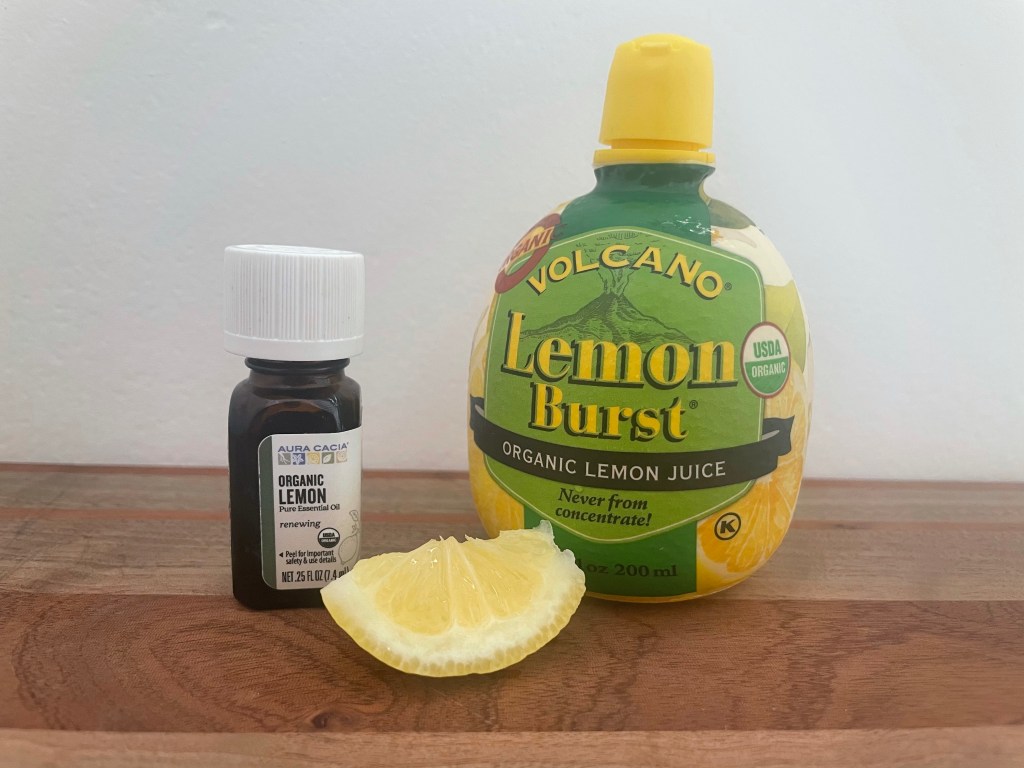
Let’s have a little talk about Lemons and Lemon essential oil….
Through the course of the last 30 years that I have been working with essential oils, I have had many conversations that are telling to misconceptions regarding their safe use.
One of the more common misconceptions that is often shared with me, is the concept that essential oils are a concentrated form of the entirety of constituents found within the botanical that they are created from.
It’s important to consider that the amount of essential oil within any botanical varies depending on the botanical itself, in addition to where they are grown, as do the resulting constituents. How the botanical is extracted also lends parameters as to what constituents are present in the end product.
Now, back to Lemons…
Lemon fruit essential oil is found in the tiny pores within the rind of the fruit. In comparison, other botanicals have their essential oils woven into their matrix by way of tiny oil sacs in either their leaves, flowers, roots, seeds, bark, etc., and are typically extracted through the process of steam distillation. However citrus fruit is unique in that its essential can be mechanically squeezed out of the little sacs within their rinds.
When we consider a lemon, we can see there are distinctive separate parts to its structure: the center fruit, the pith, and the rind. The essential oil is found in the tiny pores within the rind of the fruit. The constituents of the essential oil found in lemon fruit is quite different than the contents found the entirety of the fruit itself.
Lemon rinds typically have an essential oil yield between 1-2%. Their essential oil is a volatile aromatic fluid, consisting of terpenes (about 94% mainly (+)- limonene), sesquiterpenes, aldehydes (citral, about 3.4–3.6%, and citronellal) and esters (about 1% geranyl acetate). [Clarke, 2008]
When diffused into the air, lemon essential oil can aid with concentration, and air purification, assisting the immune and respiratory systems.
For topical use, lemon essential oil should be diluted into a fixed carrier oil at 2%, or blended with other essential oils, all totaling 2%. Topically it can be helpful with the circulatory system, and various skin conditions. [EOS, 2014; Esenta, 2016]
If used topically, it is an important to consider that cold-pressed lemon essential oil is mildly phototoxic, meaning that if the skin where the oil was applied is exposed to sunlight within 12-24 hours of application, it can cause severe to permanent burns. This can still happen even when the oil is properly diluted to 2% in a carrier oil, prior to application, but has less chance of occurrence.
A 2% dilution would be a total of 12 drops of essential oil to 30 ml (1 fluid ounce) of carrier oil. If the essential oil is incorporated into a product that is rinsed off, it is not a concern. An important consideration is that if a person adds lemon essential oil to a steam bath, and then goes outside or even into a tanning bed… the lemon will travel onto your exposed skin via steam and could very likely make you more susceptible to burns due to sun exposure. [EOS, 2014]
If the lemon essential oil is extracted through the process of steam distillation, as opposed to being cold-pressed, the caution of phototoxicity is not present. The majority of lemon essential oil that is sold in the retail market is cold-pressed.
Undiluted, essential oils are flammable. Upon contacting the surface of wood furniture, it has the ability to strip its stain off; it can also remove sticky substances from glass. If added to a glass of water, Lemon essential oil will float on its surface. (As a trained aromatherapist, I advise against the practice of adding essential oil to a glass of water. I also advise against using essential oils internally, unless under the guidance of a trained medical professional who has experience in working with essential oils clinically and has extensive knowledge of their toxicity).
Lemon essential oil is quick to oxidize, and will do so as it ages. As it oxidizes it will become more likely to irritate the skin. It is important to keep lemon essential oil in a cool place, away from sunlight and exposure to heat. It is also key to keep the lid of your essential oil bottles closed to prevent from oxidation. Lemon essential oil, as with other citrus essential oils, should be used within one year of purchase, to prevent from using an oxidized oil. It keeps best in the refrigerator.
It is important to keep in mind that the above-mentioned properties of lemon essential oil are inherent with all lemon essential oil, regardless of the company that produces it.
Now let’s get back to the rest of the Lemon.
As I mentioned earlier, Lemons have three distinctive layers, the center segmented citrus, the white pith, and finally the outer rind. The contents of these consist of Vitamin C, Vitamins B1, B2, B5, potassium, pectin, fiber, and flavonoids, along with the 2% essential oil found in the pores within the rind. It’s important to keep in mind that all of the vitamins and nutrients found in the entirety of the lemon fruit itself, are not present in its essential oil.
Adding lemon juice to your water has become popular because it can have many health benefits, including:
- Aiding digestion, as the acidity of the lemon water is said to help break down food
- Helps one to stay hydrated (most of us do not drink enough water)
- Supplies a supplemental amount of Vitamin C (this prevents loosening of teeth)
- Provides a small potassium boost
- Helps prevent kidney stones
- Adds antioxidants to your diet, which helps defend against free radicals
There are also studies that are being done on the benefit of consuming dried and ground lemon peel, as well as using this ground powder in topical applications for skin care. More on that in the future…
When it comes to Lemons, as with other botanicals, there are a great many benefits to including them in your diet as a food, or as an herbal remedy. There are also a number of instances where using Lemon Essential oil can be of benefit when used properly, diluted if used topically, and with phototoxicity concerns taken into account. It’s important to consider how these two substances differ even though they are from in the same botanical. For we could just make some lemonade, if life hands us a bunch of lemons… but we could also do so many other things! What is most important it that we understand when and where to use each extraction, and when it isn’t appropriate.
To attend the upcoming class on Essential Oil Safety, on Saturday April 15, 2023, you can register here: https://square.link/u/x0mdOMhn
For information on my upcoming classes and workshops, write to rootsofalchemy@gmail.com
To see past blog posts, visit https://www.rootsofalchemy.org
For products, services, art and workshops, visit: https://www.rootsofalchemy.com
For Esenta: The Aromaticum App, visit: http://itunes.apple.com/us/app/esenta/id1073202895?mt=8
References
“Composition of essential oils and other materials.”
Sue Clarke BSc (Hons) PhD, in Essential Chemistry for Aromatherapy (Second Edition), 2008.
Essential Oil Safety, 2nd Edition.Robert Tisserand, Rodney Young Churchill Livingstone Elsevier: London, 2014.
Esenta: The Aromaticum App. Delaney, Kathryn. Kataliktic Essentials, 2015.

 Roots of Alchemy